

World Cup Preview: #31 Canada
Previewing Canada's chances at the World Cup.

Continuing on with previewing each of the 48 teams in the World Cup today, we are taking a deeper look at one of the host nations, Canada.
This is the second straight appearance for Canada at the World Cup after they failed to get out of the group stage in Qatar. The Canadians have steadily been on the rise over the last few years, with a lot of their players making moves to play in Europe. This is their third appearance, but they lost all six of their World Cup matches in their previous two trips.
For those who do not know, I have my own International Ratings, which I have built over the years, and you can find them here.
At the end of this series, I will post my final rankings before the World Cup begins. In addition, I will be simulating the World Cup, which will likely be released the week before the tournament starts.
I will go in reverse order of my rankings, starting with my lowest-rated team and working up to my top-ranked team.
This will simply be a breakdown of each team. I will save my analysis for how they match up with each team for my group previews, which will come out a little closer to the week of the World Cup.
In case you missed it, check out my previous previews:
How did they get here?
Because Canada is one of the three host nations alongside the United States and Mexico, it automatically qualified for the World Cup.
Canada Stats
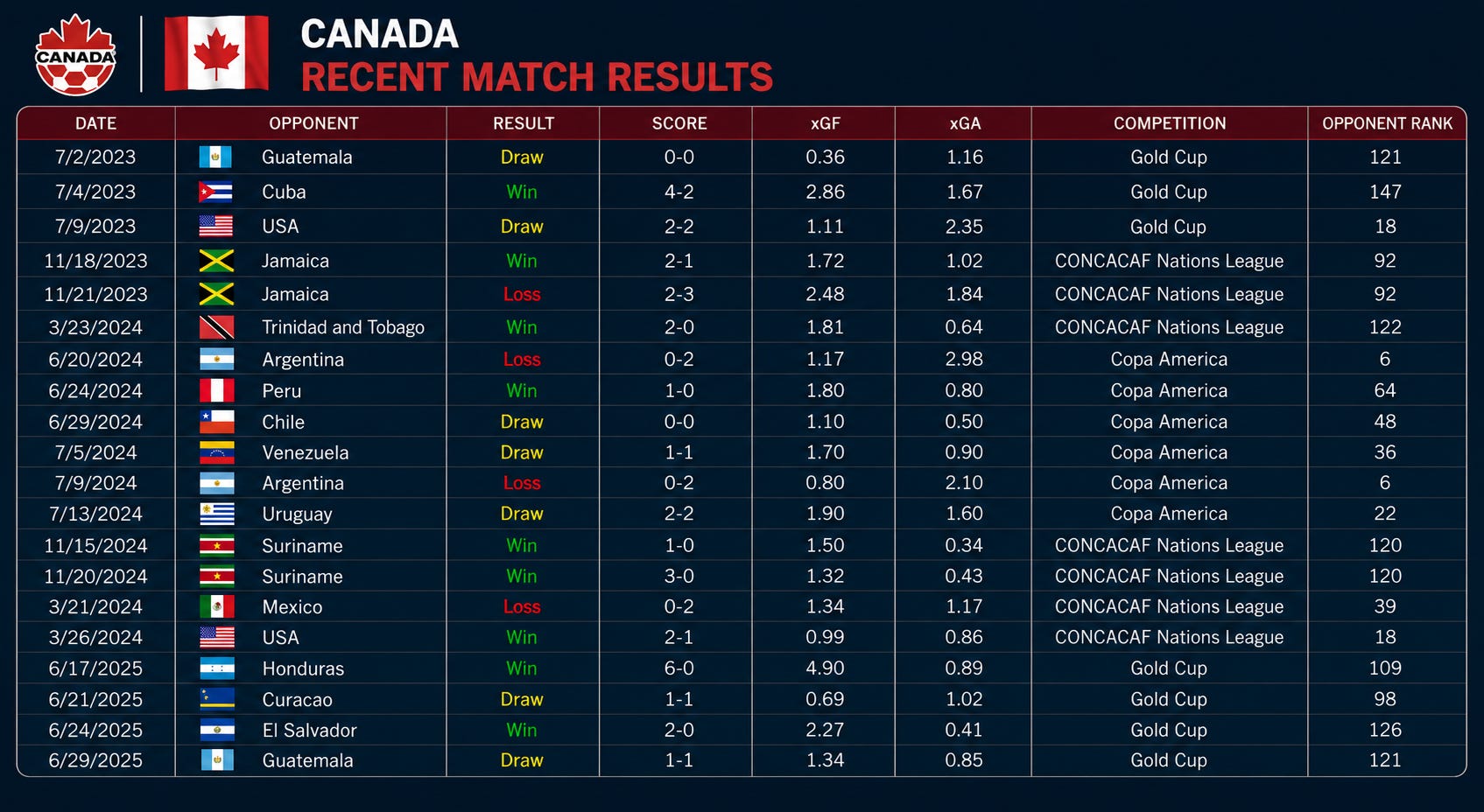
All data is from Footystats.org
Canada had a great showing at the 2024 Copa América. They went all the way to the semifinals before losing to the eventual champions, Argentina.
During that run, other than the two matches against Argentina (and the third-place match against Uruguay), they didn’t allow any of the other three opponents to create more than one expected goal.
At Copa America two summers ago, Canada led the field in fast-break shots, created the third-most xG, and completed the third-most crosses.
Defensively, even though they held Peru, Chile, and Venezuela under one expected goal, they did allow the most fastbreak shots and total xG at Copa America.
Since Copa America, Canada has lost to Mexico in the CONCACAF Nations League, but did beat the United States in the third-place match.
They undeservingly got knocked out by Guatemala at the Gold Cup, but they haven’t fielded a full-strength roster since the Copa America.
Defensively, they will press high and are effective when they do, as at the Gold Cup this past summer, when they won possession in the final third at the second-highest rate, behind only Haiti.
Canada Key Players

All data is from transfermarkt.com
Note: This is the projected roster, not the official one.
Canada’s talent pool has been improving steadily since the 2022 World Cup. Most of their players are now playing in Europe, with a couple of really big names.
The biggest name by far is Alphonso Davies.
Davies has been injured for most of the season, and it’s going to be a race against time to see if he’s fit for Canada’s first match against Bosnia and Herzegovina. He severely injured his hamstring against PSG on May 8th, and the recovery timetable is reportedly 4-6 weeks.
If he is healthy and able to play, he’s incredibly important to Canada with his pace and ability to create chances down the left flank.
Jonathan David didn’t have the best season at Juventus, but he is still a really dangerous transition striker.
He scored only six goals, the first time since 2018-19 that he’s had fewer than double-digit goals. Of course, he struggled to get playing time with two other strikers battling with him, but he did have a fairly decent 0.45 xG per 90-minute scoring rate.
I would honestly say, though, that the most important player for Canada is Ismaël Koné in central midfield.
The reason I say that is that everything for Canada hinges on how effectively they defend and transition through the middle of the pitch.
Koné had an amazing season at Sassuolo this year and was one of the best passers in Serie A.
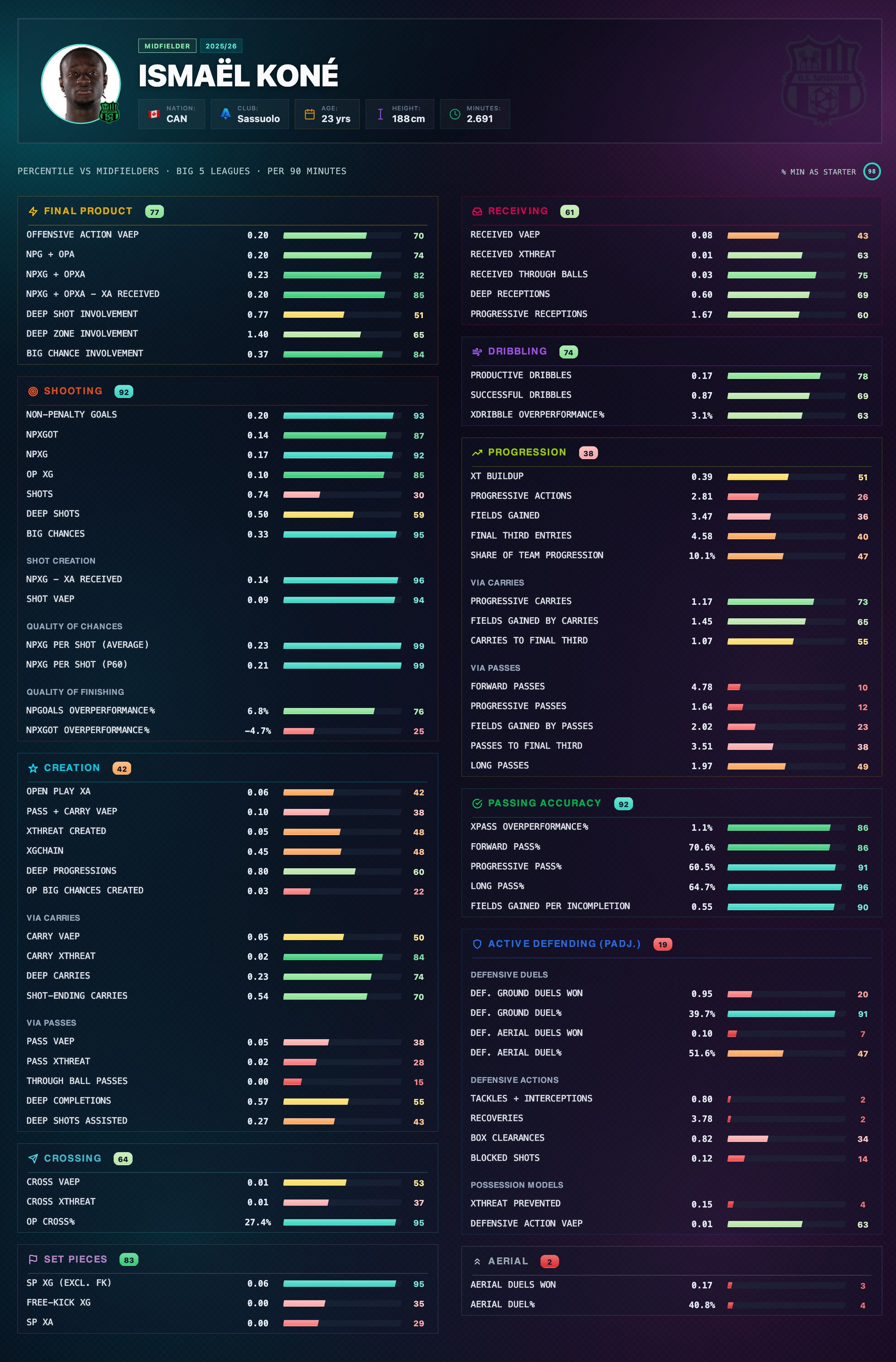
image via Scout Lab
Canada Tactics
Jesse Marsch has not changed from his days in the Red Bull system.
He typically has Canada set up in a 4-2-2-2, looking to hit teams quickly in transition, right through the middle of the pitch. For those who don’t know, this is the system Ralf Rangnick implemented at RB Leipzig almost a decade ago, which remains their identity today.
The thing is, this system really works for the players Canada has because it’s reliant on pace and intensity, which Canada definitely has.
The one thing that is very commendable about Canada is that it is not afraid to press anyone. They may have lost the semifinals of Copa América to Argentina, but they did not sit back in a low block and hope for the best.
They took the match right to Argentina and pressed them man-to-man, high up the pitch, and it kind of worked.
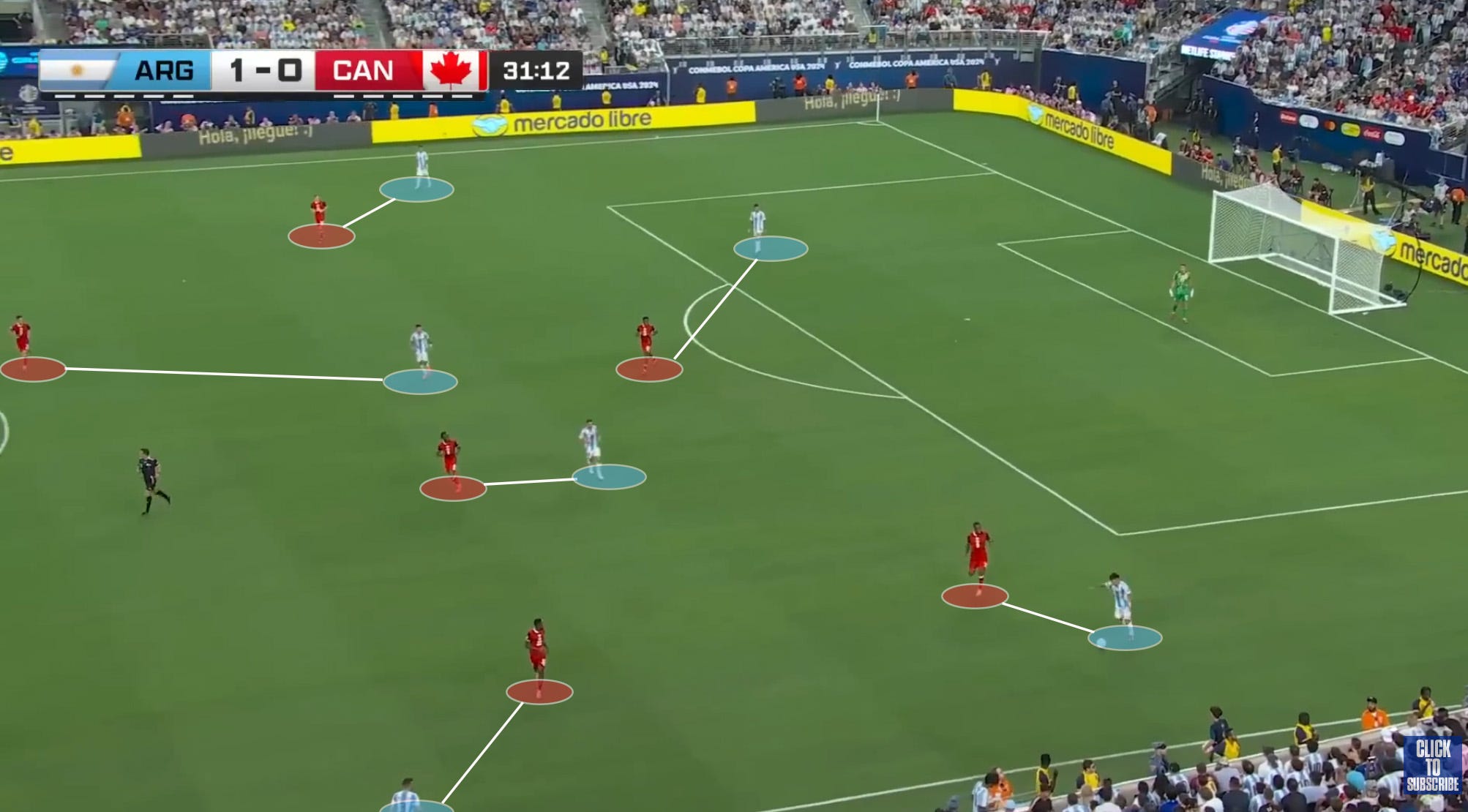
In that match, they forced six high turnovers, two of which directly led to shots.
These quick transitions after winning the ball are incredibly crucial to Canada’s offense.
The problem with Canada, though, is that they leave themselves incredibly open to counterattacks right back at them.
This was the problem when they faced Argentina in Copa America. Because they kept coming at them over and over again, once Argentina won the ball and made one pass they were able to start their own break.
This will make for some highly entertaining matches, but this can go one of two ways for Canada. Either their high risk style of play will pay or it will blow up in their face.